



01 — Definition
What Is Hentai?
Hentai is a genre of explicit adult content drawn in an anime or manga art style, typically originating from Japan. The word itself simply means "strange" or "perverted" in Japanese — but outside Japan, it has become the universal term for animated or illustrated pornography with Japanese visual aesthetics.
Unlike live-action porn, hentai is entirely fictional and illustrated. There are no real people on screen — only drawn characters. That distinction is more important than it sounds, and we'll get into why when we cover the legal side below.
🇯🇵 Japanese vs. Western Usage
In Japan, "hentai" is a broad term covering any sexual perversion or deviant behavior. The specific genre Western audiences call "hentai" is actually referred to as ero anime or etchi in Japan. But globally, "hentai" = animated adult content in the anime style — and that's the definition we're using here.
Hentai can take many forms: short animated videos (OVAs), full series, still-image manga, illustrated books, and even interactive games. What ties it all together is the art style — big eyes, exaggerated features, and the unmistakable aesthetic of Japanese animation.
It's worth noting that hentai is not the same as mainstream anime. Most anime is entirely non-sexual and produced for general audiences. Hentai is a specific adult-only subset, and the two shouldn't be confused.
02 — History
Where Did Hentai Come From?
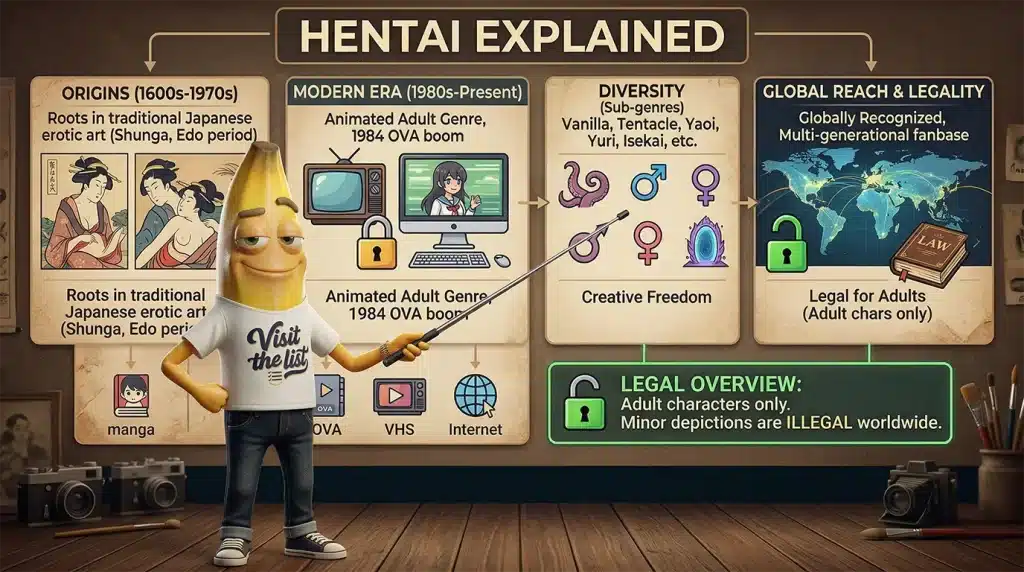
Hentai has roots stretching back centuries, though the modern animated form emerged in the 1980s. Japan has a long tradition of erotic art — including shunga, explicit woodblock prints from the Edo period (17th–19th century) that depicted sexual scenes in vivid, stylized detail.
The jump to modern hentai began with manga (Japanese comics) in the mid-20th century. As manga evolved into a dominant cultural medium, adult-oriented sub-genres grew alongside it. By the late 1970s and early 1980s, erotic manga was widely available in Japan through specialty publications.
Hentai Timeline — Key Milestones
The first animated hentai OVA (Original Video Animation) widely recognized by historians is Lolita Anime, released in 1984. This was followed quickly by other productions as VHS technology made adult content distributable outside theaters. By the late 1980s, hentai was making its way into Western markets — initially through grey-market imports and fan communities.
The internet completely transformed the genre. By the late 1990s and early 2000s, hentai had exploded online, reaching audiences globally who had never set foot in Japan. Today, hentai is a genuinely global genre with production studios, streaming platforms, and fans across every continent.
03 — Sub-Genres
What Are the Main Types of Hentai?
Hentai is not one thing — it's an enormous umbrella covering dozens of sub-genres, each with its own aesthetic, audience, and content style. Here are the most commonly encountered categories:
Vanilla
Standard romantic or sexual content between consenting characters. The most mainstream and widely consumed type. Usually features couples in explicit scenarios without extreme elements.
Futanari (Futa)
Characters with both male and female anatomy. One of the most consistently trending hentai sub-genres globally, with a massive dedicated fanbase.
Tentacle
A legendary and distinctly Japanese tradition dating back to Hokusai's The Dream of the Fisherman's Wife (1814). Tentacle hentai has mythological roots and remains an iconic genre.
Yaoi / BL
Male/male content. "Boys' Love" (BL) is a massive genre in Japan and internationally, popular especially among female readers and with a broad fanbase.
Yuri
Female/female content. Often romantic as well as sexual, with strong overlap with mainstream anime storytelling. Huge global audience.
Isekai/Fantasy
Adult content set in fantasy or alternate-world scenarios. Borrows heavily from mainstream isekai anime trends and adds explicit storytelling layers.
NTR (Netorare)
A controversial sub-genre involving infidelity or partner-sharing scenarios. One of the most debated genres — widely searched but equally widely disliked.
Femdom
Female-dominant scenarios where women are in control. Heavily overlaps with BDSM themes and appeals to both male and female audiences seeking power-dynamic content.
⚠️ Absolute Hard Line
Any hentai involving characters visually depicted as minors (even fictional ones) is illegal in many countries and morally indefensible everywhere. Legitimate hentai platforms prohibit this content. Always use platforms that have clear age-verification and content moderation policies.
Beyond these, there are dozens of more niche categories — monstergirl, futadom, ganguro, kemono (anthropomorphic animal characters), and many others. The diversity of hentai is genuinely vast, which is part of why it maintains such a broad and loyal global fanbase.
04 — Popularity
Why Is Hentai So Popular?
Hentai consistently ranks among the top-searched adult genres globally — and it's not hard to understand why once you look at what it offers that live-action porn simply can't.
1. Unlimited Creative Freedom
Live-action porn is constrained by physical reality. Hentai is not. Any scenario, any fantasy, any aesthetic can be illustrated. This makes hentai uniquely capable of serving niche desires that would be impossible or impractical to film — and that freedom is a massive part of its appeal.
2. The Anime Aesthetic
Millions of people grew up watching anime. The art style — expressive characters, vivid colors, emotionally rich storytelling — is deeply familiar and appealing to a generation raised on it. Hentai taps directly into that aesthetic attachment. For many viewers, it's not just about the sex — it's about the visual style they already love.
3. Distance from Reality
Because hentai is animated, some viewers find it psychologically easier to engage with than live-action content. There are no real people involved, which removes certain ethical discomforts some feel about traditional porn. The fictional nature creates a layer of distance that many people find makes fantasy exploration feel safer.
4. Niche Content Without the Production Cost
Producing a live-action porn video covering an extremely specific fantasy requires enormous resources. A skilled artist can draw it. This means hentai serves niches that live-action porn never will — and dedicated fans of those niches have nowhere else to go.
5. Global Search Data Doesn't Lie
Hentai — Global Search Volume vs. Other Adult Genres
Year after year, PornHub and similar platforms' annual reports confirm that "hentai" and "anime" consistently rank in the top 10 most-searched terms globally. In several countries — particularly in the US, UK, and parts of Europe — hentai outperforms many mainstream live-action categories. The numbers aren't even close.
05 — Legality
Is Hentai Legal to Watch?
In most Western countries, hentai depicting adult fictional characters is perfectly legal to watch. Because it's entirely illustrated with no real people involved, it falls outside the scope of laws targeting real-person exploitation. However, the legal picture varies significantly by country and by content type.
The Global Legal Overview
| Country / Region | Status (Adult Content) | Key Notes |
|---|---|---|
| USA | ✅ Legal | Protected under First Amendment. Obscenity laws rarely applied to animated content. Minor-depictions illegal under PROTECT Act. |
| UK | ✅ Legal | Legal for adults. Extreme pornography laws apply but generally target real-content. Possession of drawn CSAM is criminal under the Coroners and Justice Act 2009. |
| Canada | ✅ Legal | Legal for adults. Criminal Code prohibits sexual content depicting minors, including illustrations. |
| Australia | ⚠️ Grey Area | RC (Refused Classification) rules apply to some hentai content. Certain genres may be prohibited. State laws vary. |
| Germany | ✅ Legal | Legal for adults over 18. Hard restrictions on any minor-depicting content, fictional or otherwise. |
| Japan | ✅ Legal (with rules) | Legal but must censor genitalia (mosaic blurring). Export versions often uncensored for Western markets. |
| India | ⚠️ Unclear | Broad porn blocks in place. Legal status of illustrated content is ambiguous. ISP-level blocking common. |
| UAE / Saudi Arabia | ❌ Illegal | All pornographic content is illegal regardless of format. VPN usage for access is also legally risky. |
🔴 The One Absolute Rule — Everywhere
Any hentai depicting minors is illegal in virtually every country with functioning obscenity laws — including the USA, UK, Canada, Australia, Germany, and many others. Fictional or drawn doesn't mean exempt. If a character appears to be a minor, possessing that content can result in criminal prosecution. There is no grey area here.
For viewers in the USA, UK, EU, and most of the developed world: watching hentai that depicts adult characters is entirely legal. You're consuming illustrated fiction. No laws are broken. The same ethical and legal standards that apply to written erotica or adult comics apply here.
The practical takeaway: stick to reputable platforms that enforce age verification and content moderation. That protects you legally and ensures you're not accidentally accessing prohibited material.
06 — Clarification
Is Hentai the Same as Anime Porn?
Hentai and "anime porn" are often used interchangeably, but there's a distinction worth knowing. "Anime" refers to the broader world of Japanese animation — which includes everything from children's shows to action series to romance dramas. Most of it is completely non-sexual.
"Anime porn" can technically refer to any sexually explicit content in an anime visual style, including ecchi (suggestive but not explicit mainstream anime) versus full hentai (explicitly sexual). Here's how they break down:
| Term | What It Means | Explicit Content? |
|---|---|---|
| Anime | Japanese animation (all types) | No — mostly family/general audience |
| Ecchi | Suggestive/risqué anime with fanservice | No explicit nudity or sex — suggestive only |
| Hentai | Explicitly sexual anime/manga | Yes — full adult content |
| Doujinshi | Fan-made manga (can be explicit) | Varies — can be SFW or explicit hentai |
| H-game / Eroge | Adult visual novels / interactive games | Yes — includes explicit animated scenes |
So technically, all hentai is anime-style porn — but not all anime-style content is hentai. When people search "anime porn" and "hentai," they generally want the same thing. The terms are functionally equivalent in the adult content world, even if purists make finer distinctions.
One thing worth noting: doujinshi (fan-made manga based on existing anime franchises) is a massive part of the hentai ecosystem. Fans create explicit content based on characters from mainstream shows like Naruto, Dragon Ball, or My Hero Academia. This is technically copyright-infringing in most countries, though enforcement is rare and culturally tolerated in Japan.
07 — Research
What Does Science Say About Hentai?
Research on hentai specifically is limited, but the broader science on animated pornography offers some useful insights. Here's what we actually know — without the moral panic.
It's a Normal Part of the Fantasy Spectrum
Sex researchers generally agree that consuming illustrated sexual content — including hentai — is a normal part of human sexual behavior. Fantasy does not equal desire in the real world. People engage with fictional content that they wouldn't want (or wouldn't be interested in) in reality. That's the nature of fantasy.
The "No Real People" Argument
One argument frequently made in favor of hentai's relative psychological safety is that no real people are involved in its production. There's no exploitation, no coercion, no real bodies. For viewers with ethical concerns about traditional pornography, this is actually a meaningful differentiator.
Does It Cause Any Harm?
Current academic research does not support claims that consuming legal adult hentai causes measurable psychological harm in adults with healthy sexuality. The same caveats that apply to all pornography — around compulsive use, unrealistic expectations, and relationship dynamics — apply to hentai as well. Moderation and self-awareness matter, as they do with any media consumption.
📊 Worth Knowing
Studies consistently show that countries with higher rates of pornography access tend to have lower rates of sexual violence — a correlation that complicates simplistic "porn causes harm" narratives. Japan, one of the world's leading producers of hentai, has consistently low sexual crime rates by international standards. Causation isn't established, but the data doesn't support panic.
08 — Watching
Where Can You Watch Hentai Online?
There are dozens of hentai streaming sites available online — from massive free platforms to curated premium sites with HD video, subtitles, and regular new releases. The quality gap between free and paid options is significant.
Free vs. Premium Hentai Sites
| Type | What You Get | Drawbacks |
|---|---|---|
| Free Sites | Huge libraries, no cost, no account needed | Ads, inconsistent video quality, occasional malware risk from sketchy players |
| Premium Sites | HD video, English subtitles, new releases, clean UI, no ads | Monthly fee (~$10–20/month) |
| H-Games | Interactive content, visual novel format, rich story | Usually purchased per title, can be expensive |
| Manga/Doujinshi Sites | Static images, huge fan-made libraries, massive catalog | No video content, mostly unofficial/fan-made |
If you're looking for the best hentai sites available right now — both free and premium — TopPornSites.com maintains an up-to-date directory of top-rated hentai platforms, sorted by quality, content library, and value. It's the fastest way to find what's actually worth your time.
For those specifically interested in the best premium hentai sites (paid subscriptions with real HD content and curated libraries), check out the dedicated best premium hentai porn sites guide — it breaks down what each site offers, what it costs, and who it's best for.
What to Look For in a Hentai Site
Not all hentai platforms are equal. When choosing where to watch, prioritize: clear age verification systems, HTTPS security, transparent content policies, regular new uploads, and a site that visually distinguishes sub-genres so you can find what you actually want. Avoid sites with aggressive redirect ads or autoplay malware.
💡 Pro Tip
Premium hentai sites frequently offer trial periods or deeply discounted first-month rates. If you're curious about paid hentai content but not ready to commit, trial offers are the low-risk way to test before you subscribe. Most reputable sites allow cancellation before your first billing cycle ends.
09 — FAQ
Frequently Asked Questions About Hentai
Is hentai considered real pornography?
Yes — hentai is a form of adult pornographic content. The key difference from live-action porn is that it's entirely illustrated and fictional, with no real people involved in its creation. It falls under the same adult content category legally and socially, and is restricted to adults in countries with age-gating laws.
Does watching hentai mean you're attracted to real people who look like anime characters?
No. Fantasy preferences in media don't directly translate to real-world attractions. Plenty of hentai viewers are entirely attracted to real people and simply enjoy the creative freedom and aesthetic of animated content separately. Sexual psychology is more nuanced than a 1:1 content-to-desire mapping.
Why is so much hentai censored with pixel blurring?
Japanese law (specifically Article 175 of the Penal Code) requires that genitalia in pornographic material be obscured — hence the mosaic censoring you see on official Japanese releases. Hentai produced for Western markets, or fan-edited versions, are often "uncensored" because they were either created outside Japan or had the censoring removed before export.
What's the difference between hentai and ecchi?
Ecchi is suggestive and risqué anime content — lots of fanservice, partial nudity, and sexual tension — but stops short of showing explicit sex or genitalia. It's the "soft" version. Hentai is full-on explicit adult content. Think of ecchi as a mainstream anime with a steamy shower scene, and hentai as the full version with nothing left to the imagination.
Can you get in legal trouble for watching hentai?
In most Western countries — USA, UK, Canada, EU — watching hentai depicting adult characters is completely legal. No laws are broken. The only absolute exception is content depicting minors, which is illegal to possess, view, or distribute regardless of whether it's drawn or real, in virtually every jurisdiction with functioning obscenity law.
Is hentai more popular than regular porn in some countries?
In terms of search volume, hentai consistently ranks as one of the top-searched adult terms globally and outperforms many live-action categories in countries like the USA, UK, Japan, and parts of Southeast Asia. It's the dominant genre in certain demographics — particularly among younger viewers aged 18–30 who grew up with anime culture.
What is tentacle hentai and where did it come from?
Tentacle hentai features sexual scenarios involving tentacled creatures. Its origins trace back to Katsushika Hokusai's 1814 woodblock print "The Dream of the Fisherman's Wife" — one of the most famous artworks in Japanese history. Modern tentacle hentai is a direct descendant of this tradition and remains one of the most culturally recognized (and often parodied) sub-genres of the form.
10 — Summary
Key Takeaways
What You Need to Remember
- Hentai is illustrated adult content in an anime/manga art style. No real people are involved in its creation, which sets it apart from all live-action porn.
- It's been around for decades — the modern form emerged in the 1980s, but its roots in Japanese erotic art go back centuries. It's a legitimate cultural form, not a new internet phenomenon.
- The genre is enormous — from vanilla romance to tentacle fantasy to femdom and yaoi. If a fantasy exists, hentai has a sub-genre for it.
- It's legal in most Western countries for adults, as long as it depicts adult characters. Content depicting minors is illegal everywhere — no exceptions, no grey areas.
- It's genuinely popular — consistently a top-10 global adult search term, with a multi-generational fanbase that grew up with anime culture.
- For the best sites, use curated directories like TopPornSites.com rather than random Google results — quality and safety vary wildly across platforms.